Lab Exercises
| 1. | a) | Write a method named evaluate which
accepts values for a, b, and c and returns the value of the equation: |
||||||
| b) | Use the above method in a program named Solve that will allow the user to enter in values for a, b, and c. | |||||||
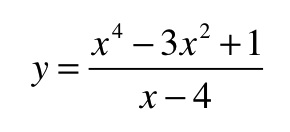
| 2. | a) | Create a method that will calculate the value of the equation:
and return "positive", "negative", or "zero" based on the value of the equation. |
||||||
| b) | Create a main method that will allow the user to enter in a value for x and see the return value of the method. | |||||||
| 3. | a) | Write a double method named wages that takes the payrate/hour and hours worked and then calculates and returns the wages earned. "Time and a half" is paid (150% of your normal wage rate) for every hour worked over 40 hours. | ||||||
| b) | Write a program called Payroll that calculates the wage for ONE employee. Enter in the hours worked and the payrate, calculate the amount of pay, and display the result. | |||||||
| c) | Write a program called Payroll1 to calculate the wage for 3 employees. Use a for loop to enter in the hours worked and payrate for each. Use the wages method to find and display the amount to be paid. Information on the for Loop. Enter hours worked: 20 |
|||||||
| d) | Write a program called Payroll2 to calculate
the wages for 3 employees using the method wages. Have the program reject negative hours or
wages and ask for correct information as shown below. You should use a while loop to repeat the question until a "good" number has been entered. Information on the while Loop.
Enter hours worked: 10 |
|||||||
| 4. | a) | Write a method of type long (think of it
as a large whole number - no decimals), named factorial
that returns the factorial of an int parameter. The factorial of a
number is the product of all positive integers less than or equal to that
number. For example, the factorial of 5 (written 5!) is: 5! = 1 * 2 * 3 * 4 * 5 = 120 Hint #1: use a loop to do the
multiplication. NOTE: the code will give you some crazy values if you don't use type long. |
||||||
| b) | Write a program named MathCalculation that will allow the user to enter in a value to use with the factorial method. Have the code repeat until the user enters a 'Q' to quit the program. | |||||||
| 5. | a) | Write separate double methods to calculate
each of the following conversions:
|
||||||
| b) | Write a program that combines these three
functions so that the user can select one of them.
1. Pound to kilograms Enter centimetres: 1000 |
|||||||
| 6. | a) | A prime number is any integer that is evenly
divisible only by itself and 1. For example, the numbers 2, 3, 5, and 7
are prime while 9, 10, and 15 are not. Write a boolean method named
prime that accepts an integer greater than 1 and then returns true
if the integer is prime or false if it is not. The computer tests
an integer by repeatedly dividing it by integers smaller than itself but
larger than 1, and checking whether the remainder is 0. If so, the integer
is not prime. Hint: you used a structure to do this in Question #2 of the Looping Assignment. It is called "mod". Go back and review it for this question. |
||||||
| b) | Write a program that class prime with all integers between 2 and 100 and prints only those that are prime. | |||||||
| 7. | a) | Create a method that will return an
int value based on the roll of a die.
See How to get a random number here. |
||||||
| b) | Have the main method call the method in a) two
times. This will simulate rolling 2 dice. Display the total value of the
roll. e.g.
|
|||||||
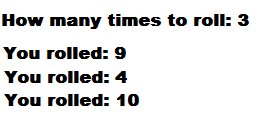
| c) | Update the program so that you ask the user how
many times to roll the 2 dice and display the total of each roll. e.g.:
|
|||||||
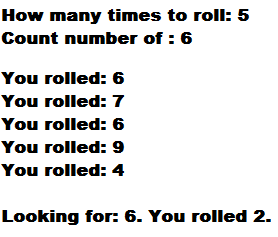
| d) | Update the program so that you keep track of
how many times you roll 7 OR some other number that you enter. (You roll 2
dice.) e.g.
|
|||||||
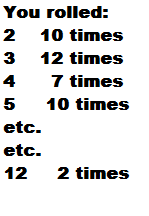
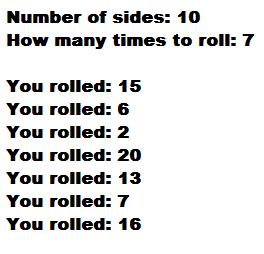
| 8. | Use the rolling dice idea to roll two dice 100
times and count the number of times EACH total comes up. That is, create a
variable for each possible total and when you roll that number, add one to
it. e.g.:
|
|||||||
| 9. | Make a NEW program, similar to the question
above. In this one, you indicate how many sides are on the dice. (You roll 2
dice.) e.g.
|
|||||||