Terminology
| access | The ability to use a method or variable. |
| access control | The ability to allow or prevent access to a method or variable. |
| argument | Information provided in a message in addition to the method name and ultimately made available to the method via a parameter, one of the two ways that methods get needed information. |
| behaviour | Any action that the object may take, any change it may undergo, or any characteristic it may reveal as a result of a method being invoked. |
| class method | A method that is not associated with any particular object or a class but rather the class itself. As a result, it can be invoked without reference to an object. Such a method is also called a static method. |
| constructor | A method that is invoked when an object is created. The name of the constructor method is the same as the corresponding class name. The purpose of the constructor is to guarantee a reasonable and consistent state at the time of object creation. |
| default | A behaviour or value that is used if no explicit behaviour or value is provided. |
| implement | Provide the code that realizes a design. |
| implementation | The specific code that realizes a class. |
| initialized | Given a first value. |
| instance variable | A variable that is declared within a class but outside of any method; its purpose is to store information needed by methods to be preserved in between invocations. Each object has its own set of instance variables that have their own unique values - it is these values that distinguish one object from another. The entire set of the instance variables of an object define its state. |
| local variable | A variable that is declared within a method; it exists only during the invocation of the method and is used as a temporary convenient holder of information. |
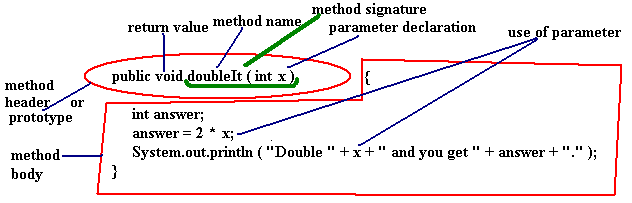
| method | A self-contained section of code belonging to a class that achieves a specific behaviour for that class. A method consists of a return type, method name, and parameter list, all of which form the method's signature, and the section of code that is called the body of the method. |
| parameter | A variable that is declared in the parentheses of a method signature and whose purpose is to store the value of the corresponding argument; naturally, the type of the argument and the parameter must match in some sense. |
| prepend | Place in front of, place before. |
| private | A keyword modifier in a method definition or instance variable declaration that prevents access to a method or variable from any code outside the class. |
| prototype or method header |
Part of a method definition that consists of return-type, method name and argument list in parentheses. |
| public | A keyword modifier in a method definition or instance variable declaration that allows access to a method or variable from any code outside the class. |
| reference | A value whose sole significance is that it refers to an object and hence can be used to send messages to that object. |
| responsibility | The characteristic of being obligated to provide a certain behaviour or carry out a certain task. |
| return | A verb keyword that allows a method to terminate its own execution and allows the sender of the message to resume execution; additionally, the return statement allows the method to send some information back to the receiver. |
| return-type | The first part of the prototype; it specifies what kind of information will be returned by the method. |
| signature | A method's name along with a description of its arguments. |
| state | The collection values of the instance variables of an object at any given time. |
| static method | See class method. |
| this | A pronoun keyword that refers to the current object; this allows for convenient reference to the objects instance variable, particularly when the parameters have the same name. |
Source: Arnow, David & Gerald Weiss. Introduction to programming using Java: an object-oriented approach. Java 2 update. Addison-Wesley, Don Mills, Ontario. 2000. ISBN 0-201-61272-0. pg 50,92, 126-128